Social Security 2026: Demographics & Future Impact
Anúncios
Shifting US demographics, particularly an aging population and declining birth rates, are projected to significantly strain the Social Security system by 2026, necessitating careful policy adjustments to ensure its long-term solvency.
Understanding the future of vital programs like Social Security is paramount for every American. This article provides Insider Knowledge: How Shifting Demographics Will Impact US Social Security by 2026 – A 10-Year Projections Analysis, delving into the intricate relationship between demographic trends and the solvency of this cornerstone of retirement security. What does the next decade hold for your benefits?
Anúncios
The Looming Demographic Shift: An Overview
The United States is undergoing a profound demographic transformation. This shift is characterized primarily by an aging population and, concurrently, a deceleration in birth rates. These two factors are converging to create a unique challenge for the Social Security system, which relies on a steady influx of younger workers to support its current beneficiaries.
The implications of this demographic change are not theoretical; they are already beginning to manifest. By 2026, these trends are projected to exert significant pressure on the program’s financial stability, demanding a closer look at the underlying dynamics and potential outcomes. Understanding these forces is the first step toward informed discussion and proactive solutions.
Understanding the Aging Population
The baby boomer generation, a large cohort born between 1946 and 1964, has been entering retirement for several years and will continue to do so through 2030. This demographic bulge means a substantial increase in the number of Social Security beneficiaries.
- Increased Beneficiaries: More people are drawing benefits for longer periods due to increased longevity.
- Lower Worker-to-Retiree Ratio: Fewer active workers are contributing per retiree, straining the system.
- Healthcare Costs: An older population also typically incurs higher healthcare costs, indirectly impacting overall economic stability.
Declining Birth Rates and Their Effects
Simultaneously, the US has experienced a sustained decline in birth rates over recent decades. This trend exacerbates the challenges posed by an aging population, as fewer new workers enter the labor force to replenish the contributor base.
The long-term effects of this are significant. A smaller younger generation means a smaller tax base in the future, further widening the gap between contributions and payouts. This demographic reality underscores the urgency of addressing Social Security’s long-term sustainability.
In essence, the combination of an aging population living longer and fewer new births creates a demographic imbalance that directly threatens the traditional pay-as-you-go model of Social Security. The next section will delve into the specifics of how these shifts translate into financial pressures on the system.
Anúncios
Social Security’s Financial Framework: How It Works
To fully grasp the impact of demographic shifts, it’s essential to understand the fundamental financial architecture of Social Security. This program operates on a pay-as-you-go system, meaning that current workers’ contributions largely fund the benefits of today’s retirees and other beneficiaries. It’s not a personal savings account, but rather an intergenerational transfer system.
The system relies heavily on a healthy dependency ratio, which is the number of retirees and other beneficiaries supported by each active worker. When this ratio becomes unfavorable, the system faces financial stress.
The Pay-As-You-Go Model Explained
The core principle of Social Security is straightforward: payroll taxes collected from current workers are used to pay current benefits. Any surplus is invested in special Treasury bonds, forming the Social Security Trust Funds. These funds act as a reserve, providing a buffer against economic downturns or demographic imbalances.
- Payroll Taxes: The primary funding source, split between employees and employers.
- Trust Funds: Reserves built from past surpluses, providing a safety net.
- Benefit Payments: Disbursed to retirees, disabled individuals, and survivors.
Key Financial Indicators to Watch
Several financial metrics are closely monitored to assess the health of the Social Security system. These include the annual cost rate, the income rate, and the actuarial balance. A negative actuarial balance indicates a projected shortfall over the long term.
The Social Security Administration (SSA) regularly publishes detailed reports outlining these projections. These reports are crucial for policymakers and the public to understand the program’s financial standing and the potential need for adjustments. By 2026, these indicators are expected to show increased strain due to the demographic trends discussed.
Ultimately, the financial health of Social Security is a delicate balance between incoming contributions and outgoing benefits. As demographics shift, this balance is increasingly challenged, prompting the need for proactive measures to maintain the system’s solvency for future generations.
Projected Impact by 2026: A 10-Year Outlook
By 2026, the confluence of an aging population and lower birth rates is expected to exert noticeable pressure on the Social Security Trust Funds. While the system is not projected to collapse, the financial strain will become more pronounced, potentially leading to a drawdown of reserves at an accelerated pace. This 10-year projection highlights critical challenges that demand attention.
The Social Security Administration’s own forecasts have consistently pointed to these challenges, emphasizing the need for policy adjustments sooner rather than later. Ignoring these projections could lead to more drastic measures being required in the future.
Trust Fund Depletion Projections
Current projections indicate that the Social Security Trust Funds could be depleted in the mid-2030s if no legislative action is taken. By 2026, the rate at which these funds are drawn down is expected to increase. This means that a larger portion of current benefits will be paid directly from current payroll taxes, rather than supplemented by interest from the trust funds.
The depletion of these reserves does not mean benefits stop entirely. Instead, it implies that Social Security would only be able to pay out approximately 75-80% of promised benefits, based on incoming tax revenues. This potential reduction would have significant implications for millions of retirees and their families.
The Worker-to-Beneficiary Ratio: A Growing Concern
The worker-to-beneficiary ratio is a critical metric for Social Security’s sustainability. In the 1970s, there were about 3.7 workers for every Social Security beneficiary. Today, that number has fallen to around 2.8. By 2026, this ratio is projected to decline further, intensifying the financial burden on the working population.
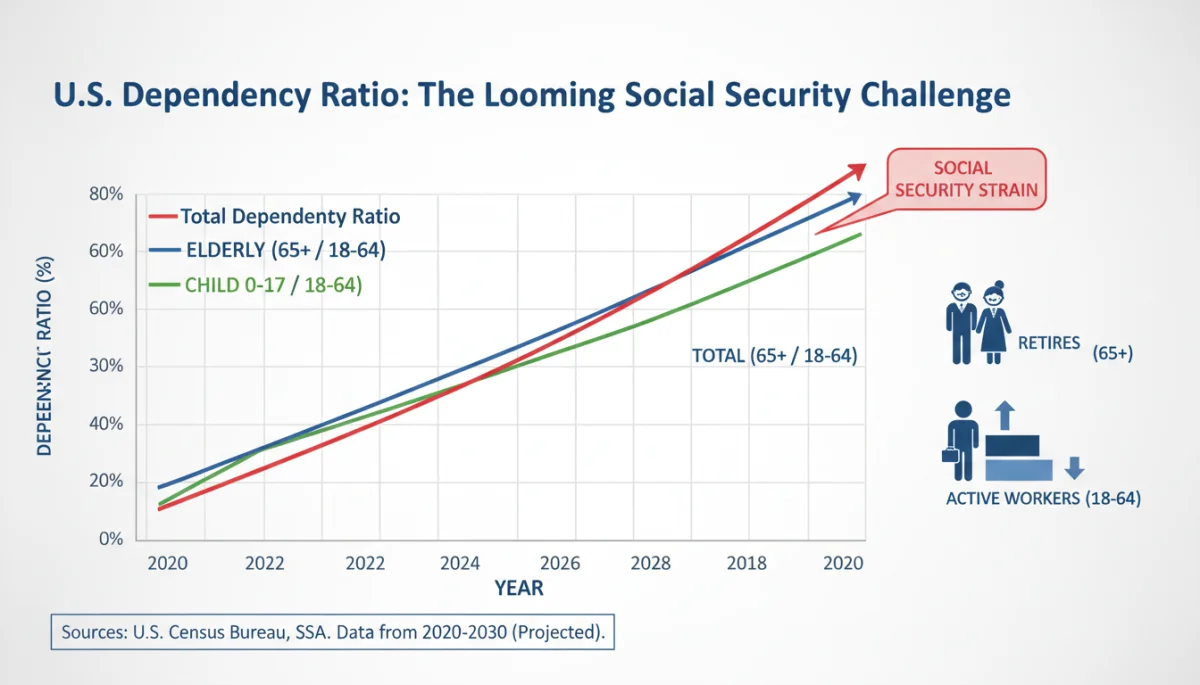
A lower ratio means that fewer workers are contributing payroll taxes for each person receiving benefits. This imbalance is the direct result of lower birth rates leading to fewer entries into the workforce, combined with longer life expectancies for retirees. The system was designed for a different demographic reality, and these shifts require a re-evaluation of its current structure.
The 2026 outlook underscores that while immediate crisis is unlikely, the trajectory points towards significant challenges that require thoughtful and timely interventions. The next section explores how these demographic shifts are influenced by broader societal trends.
Broader Societal Trends Influencing Social Security
Beyond the direct numbers of births and deaths, several broader societal trends are playing a significant role in shaping the future of Social Security. These interconnected factors complicate the demographic picture and add layers of complexity to policy discussions. Understanding these influences is crucial for a holistic view of the challenges ahead.
These trends are not isolated; they interact with each other to create a dynamic and evolving landscape for the Social Security system. From healthcare advancements to economic shifts, the context is constantly changing.
Increased Longevity and Healthcare Advances
One of the most remarkable achievements of modern society is the significant increase in life expectancy. While undoubtedly a positive development, it presents a challenge for retirement systems like Social Security. People are living longer, healthier lives, meaning they collect benefits for more years.
- Longer Benefit Payouts: Retirees draw benefits for extended periods.
- Increased Healthcare Costs: While not directly Social Security, it impacts overall federal spending and economic capacity.
- Delayed Retirement: Some individuals are choosing to work longer, which can help offset some costs but also changes workforce dynamics.
Immigration Patterns and Labor Force Growth
Immigration has historically played a vital role in US demographic and economic growth, including contributing to the Social Security system. Immigrants, often younger, enter the workforce and pay payroll taxes, helping to bolster the system.
Changes in immigration patterns, whether due to policy or global events, can therefore have a direct impact on the labor force and the Social Security contributor base. A robust and consistent flow of immigration can help mitigate some of the negative effects of declining domestic birth rates, offering a potential avenue for addressing the worker-to-beneficiary ratio.
The interplay of these societal trends paints a complex picture for Social Security. While increased longevity is a triumph, its financial implications must be managed. Similarly, immigration’s role as a demographic stabilizer needs careful consideration in future policy debates. The final sections will explore potential solutions and the urgent need for action.
Potential Solutions and Policy Considerations
Addressing the challenges posed by shifting demographics to Social Security requires a multi-faceted approach. There is no single, easy solution, and any effective strategy will likely involve a combination of reforms. The goal is to ensure the program’s long-term solvency while maintaining its core mission of providing a safety net for millions of Americans.
These policy considerations often involve difficult trade-offs, making open and informed public discourse essential. The longer action is delayed, the more significant and potentially disruptive the necessary changes become.
Adjusting the Retirement Age
One frequently discussed option is gradually increasing the full retirement age. As people live longer and healthier lives, working for a few more years could significantly reduce the total duration of benefit payouts and increase the period of contributions.
This approach has historical precedent; the full retirement age has been raised in the past. However, it raises questions about equity, particularly for those in physically demanding jobs or with differing life expectancies. Any adjustment would need to be phased in carefully to minimize adverse impacts on vulnerable populations.
Modifying Benefit Formulas
Another avenue for reform involves adjusting the benefit calculation formulas. This could include changes to how benefits are indexed to inflation, or how initial benefit amounts are determined. Even small adjustments can have a substantial cumulative effect over many years.
- CPI Adjustments: Changing the Consumer Price Index (CPI) used for cost-of-living adjustments.
- Progressive Indexing: Modifying benefit growth for higher earners while protecting lower earners.
- Means Testing: Introducing income thresholds for benefits, though this is often controversial.
Increasing Payroll Taxes
Increasing the Social Security payroll tax rate or raising the cap on earnings subject to the tax are direct ways to boost the program’s revenue. A modest increase in the tax rate, spread across all workers, could significantly improve the financial outlook.
Similarly, raising or eliminating the taxable earnings cap, which currently limits Social Security taxes to earnings up to a certain amount, would increase contributions from higher earners. These options, while effective, often face political resistance due to their direct impact on workers’ paychecks.
The path forward will likely involve a blend of these and other solutions. The key is to find a politically viable and economically sound combination that addresses the demographic realities without undermining the fundamental purpose of Social Security. The time for these discussions and decisions is rapidly approaching.
The Urgency of Action and Future Implications
The projections for Social Security by 2026 and beyond underscore a clear message: the time for decisive action is now. While the system is not facing immediate collapse, the demographic trends are undeniable, and delaying reforms will only lead to more difficult choices down the road. The longer policymakers wait, the more drastic the necessary adjustments will become, potentially impacting current and future retirees more severely.
The future implications of inaction are significant, not just for beneficiaries but for the broader US economy and societal stability. Social Security is a vital component of the social safety net, and its long-term health affects millions of American families.
Impact on Future Generations
Without reform, younger generations face the prospect of either reduced benefits or significantly higher payroll taxes. This intergenerational equity concern is central to the debate. Ensuring that Social Security remains a viable program for those currently in their working years is a moral and economic imperative.
The burden of an unsustainable system could stifle economic growth, reduce consumer spending among retirees, and lead to increased poverty rates among the elderly. These are outcomes that policymakers and the public should strive to avoid through proactive measures.
Economic Stability and Confidence
Social Security also plays a crucial role in maintaining economic stability. It provides a steady income stream to millions, which supports consumer demand and reduces reliance on other forms of public assistance. Uncertainty about the program’s future can erode public confidence and impact retirement planning decisions.
A strong, solvent Social Security system contributes to overall economic confidence and allows individuals to plan for their futures with greater certainty. Conversely, concerns about its stability can create anxiety and lead to a more cautious economic environment.
In conclusion, the demographic shifts impacting US Social Security by 2026 are not merely statistical anomalies; they represent a fundamental challenge to a bedrock American institution. Addressing these challenges requires courage, foresight, and a willingness to engage in constructive dialogue to secure the program for generations to come.
| Key Point | Brief Description |
|---|---|
| Demographic Shift | Aging population and lower birth rates strain the Social Security system. |
| Financial Pressure | Trust Funds face accelerated drawdown by 2026 due to fewer workers supporting more retirees. |
| Policy Solutions | Options include adjusting retirement age, modifying benefits, or increasing payroll taxes. |
| Urgency of Action | Timely reforms are critical to ensure long-term solvency and economic stability. |
Frequently Asked Questions About Social Security’s Future
The main challenge is the growing imbalance between the number of retirees and beneficiaries receiving payments and the number of active workers contributing payroll taxes. An aging population and declining birth rates mean fewer workers are supporting more beneficiaries, straining the system’s finances.
No, Social Security is not projected to run out of money by 2026. However, the Trust Funds are expected to begin drawing down at an accelerated rate, potentially leading to a shortfall in the mid-2030s if no legislative action is taken to address the financial imbalance.
Increased longevity means that individuals are living longer and, consequently, collecting Social Security benefits for more years. While a positive societal development, it extends the period of benefit payouts, placing greater financial demands on the system than it was originally designed to accommodate.
Proposed solutions include gradually raising the full retirement age, modifying benefit calculation formulas (e.g., through changes to cost-of-living adjustments or progressive indexing), and increasing payroll taxes or the taxable earnings cap. A combination of these measures is often considered most effective.
Addressing these challenges now allows for more gradual and less disruptive adjustments. Delaying action will likely necessitate more severe reforms in the future, potentially imposing greater burdens on future generations or leading to more significant benefit reductions for current and future retirees, impacting economic stability.
Conclusion
The detailed analysis of how shifting demographics will impact US Social Security by 2026 reveals a critical juncture for this indispensable program. The convergence of an aging population living longer and persistent low birth rates is creating an undeniable strain on the system’s financial integrity. While immediate collapse is not on the horizon, the projections clearly indicate an accelerating drawdown of the Trust Funds, signaling the urgent need for comprehensive reforms. Policymakers and citizens alike must engage in constructive dialogue to explore viable solutions, ranging from adjustments to the retirement age and benefit formulas to modifications in payroll taxes. Proactive, thoughtful action is essential to ensure that Social Security continues to provide a vital safety net and maintains economic stability for all Americans, safeguarding its promise for future generations.
